
Best APS-C Canon Lenses: Starter To Pro
Need a new lens for your APS-C sensor Canon camera? Then you’re in the right place! This detailed review features ten lenses for Canon cameras with cropped sensors, and there’s definitely one that’s good enough for you!
At A Glance: Best Canon APS-C Lenses
- Best Budget Zoom Lens Canon EF-S 55-250mm f/4.0-5.6 IS II Telephoto Zoom LensJump To Review
- Best Budget Prime Lens Canon EF-S 24mm f/2.8 STM LensJump To Review
- Best Wide Angle Lens Canon EF-S 10-18mm f/4.5-5.6 IS STM LensJump To Review
- Best Value For Money Canon Portrait and Travel Two Lens KitJump To Review
- Best (Full Frame) Lens For Portraits Canon EF 50mm f/1.4 USM Prime Lens Jump To Review
- Best All-Purpose Lens Canon EF-S 18-200mm f/3.5-5.6 IS Standard Zoom LensJump To Review
Whether you’re looking for an all-purpose lens for travel, a wide-angle option for photographing landscapes, or something with a high aperture so you can shoot stunning portraits, there’s a great option for you! And I’ve separated the lenses into different price ranges, so there’s something for everyone’s budget.
Top Product Overview
 | Best Budget Zoom Lens
| SEE ON AMAZON → |
 | Best Budget Prime Lens
| SEE ON AMAZON → |
 | Best Wide Angle Lens
| SEE ON AMAZON → |
 |
| SEE ON AMAZON → |
 | Best Value For Money
| SEE ON AMAZON → |
 | Best (Full Frame) Lens For Portraits
| SEE ON AMAZON → |
 |
| SEE ON AMAZON → |
 |
| SEE ON AMAZON → |
 |
| SEE ON AMAZON → |
 | Best All-Purpose Lens
| SEE ON AMAZON → |
Top Products
Best Lenses Under $300
Best Budget Zoom LensCanon EF-S 55-250mm f/4.0-5.6 IS II Telephoto Zoom Lens
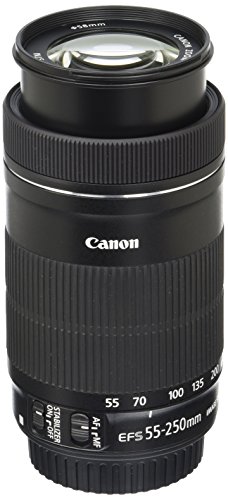
The 55-250mm lens is a great purchase for anyone who owns a standard 18-55mm kit lens. It lets you photograph subjects that are much further away, making it a great option for photographing animals, flowers, and even sports. The minimum focusing distance for the lens is 3.6 ft, meaning you will be able to get some great close-ups when you zoom in a little.
This is also one of the most affordable zoom lenses for Canon APS-C sensor cameras, so it’s a great buy if you’re on a tight budget. But it is worth noting that you get what you pay for – with a maximum aperture of f/4-5.6, this lens is not a good option for portraits. You won’t be able to get the smooth background blur with that aperture, so keep that in mind.
The lens has built-in image stabilization, which is great for photographing moving objects. It’s actually why this lens is great for sports – you can easily zoom in on subjects that are far away on the field, and the fast focus and shutter will get you a perfectly sharp photo every time.
And the stepping motor focus is practically silent, so it’s great for shooting videos since the camera microphone most likely won’t even pick it up.
On top of that, this lens weighs just a little under 14 ounces, making it one of the lighter telephoto zoom lenses you can get. And the weight is important, especially if you plan to walk around with the camera and the lens around your neck for hours at a time.
However, it is worth noting that the really great telephoto lenses can cost several thousands of dollars, so try to control your expectations with this affordable alternative.
Pros
- Great value for money
- Silent stepping motor focus
- Lightweight
Cons
- Maximum aperture of f/4
- Not great for portraits
Product Information
- Focal Length: 55-250mm
- Built-In Stabilization: Yes
- Weight: 13.8 ounces
Canon EF-S 24mm f/2.8 STM Lens

The 24mm prime lens is a great affordable option. This is a wide-angle lens that is great for photographing landscapes, buildings, and pretty much anything relating to street and travel photography. It is also very affordable, so it’s great for people who are on a tight budget and want something good for travel.
The low aperture can also get you some beautiful portraits with smooth bokeh, but you will need to get a bit closer to your subjects. The minimum focusing distance is 0.5 ft, so that shouldn’t be a problem!
It’s also worth noting that the lens doesn’t have image stabilization, so it’s not the best for long-exposure photos and moving subjects. A steady hand is a must with this lens, but you shouldn’t have any issues when shooting in bright conditions at fast shutter speeds.
One of the best things about this lens is how small and lightweight it is. That’s one of the things that makes this lens great for travel – while the bigger zoom lenses might be more versatile, they can also weigh more than 1 lb.
But this lens weighs only some 4 ounces, so you don’t have to worry about the weight restrictions for your luggage and you’re not going to experience horrible neck pains when you’re walking around with this lens.
Another thing important to mention is that this Canon lens features an STM focus motor. It’s not as fast as their ultrasonic motor, but it is much quieter. This is the preferred focus for people who love shooting videos since it’s so quiet that camera microphones rarely pick it up.
Pros
- Very affordable
- Great for travel and street photography
- Lightweight and portable
Cons
- Not very versatile
- No image stabilization
Product Information
- Focal Length: 24mm
- Built-In Stabilization:
- Weight: 4.41 ounces
Canon EF-S 10-18mm f/4.5-5.6 IS STM Lens

If you want a good lens for photographing landscapes and architecture, the 10-18mm option from Canon is a great choice. This is a wide-angle lens that’s perfect for street photography and a great option for any traveler. Especially because it weighs only 0.5 lbs – you won’t get uncomfortable or fatigued quickly with this lens on your camera.
The wide-angle lens features a maximum aperture of f/4.5 at the lower end of the focal range, and that’s good enough for landscape shots. It won’t get you stunning portraits with creamy bokeh, but that’s not what this lens is designed for anyway.
Also, this Canon lens boasts a stepper motor focus that is fast and practically silent. It’s a great lens for filming videos because the motor is so quiet that the microphone is unlikely to pick it up. This is also one of Canon’s lightest focus motors, which would explain why this lens is so lightweight.
On the other hand, it’s also worth noting that the STM focus is thought to be the low-end of Canon focus motors. Their other alternatives might not be as silent as this one, but they are much faster. The upside is that the speed of these motors is measured in milliseconds, so it’s not likely that you’ll notice a massive difference, especially if you haven’t used lenses with (NANO) USM focus motors.
I should also point out that this Canon lens has built-in image stabilization for perfectly sharp shots every time. It will perform great in long exposure shots and I would highly recommend getting a few filters for this purpose. Good UV filters will allow you to take long exposure shots in daylight, and they are crucial if you want those mesmerizing long-exposure shots of rivers and streams.
Pros
- Excellent wide-angle lens
- Lightweight and portable
- Great for long exposure shots
Cons
- Not good for portraits
- STM focus motor is Canon’s lower end option
Product Information
- Focal Length: 10-18mm
- Built-In Stabilization: Yes
- Weight: 0.53 lbs
Best $300-$500 Lenses
Canon EF-S 35mm f/2.8 Macro IS STM
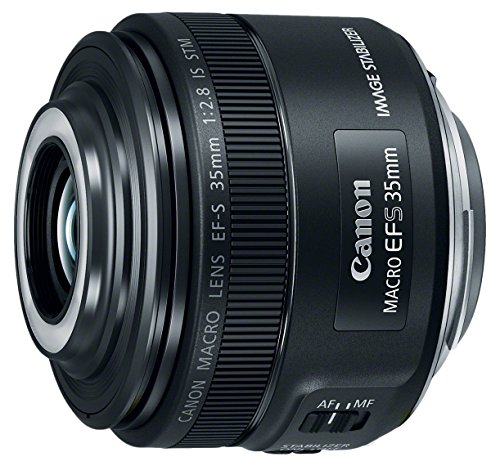
The 35mm f/2.8 macro lens for Canon cameras is a good option if you want a slightly more versatile prime lens. It is a macro lens by default, but the 35mm focal length can work for portraits, landscapes, and even travel.
The high aperture of the lens guarantees you can get photographs with the subject in sharp focus and silky smooth bokeh in the background. And that’s the definition of a good portrait! Plus the lens is only a little under $300, so you’re getting great performance at an affordable price tag.
This prime lens has built-in image stabilization, guaranteeing sharp photos on the go. It boasts Canon’s STM focus motor, which is smooth, silent, and fast. It’s not the most sophisticated focus motor they have, but it is great for shooting videos because of how quiet it is. It’s also one of their more affordable options, hence an attractive price point.
This lens also has a built-in Macro Lite feature, for stunning detail in close-ups. It allows you to adjust the lighting, so you have full control over the photographs that you are taking. This is a great feature for macro shots, especially when you’re taking them in low light or indoors since those tend to be a bit darker.
Finally, it’s worth noting that this lens weighs just 6.7 ounces. It is portable and lightweight enough you could attach it to your camera and wear it around your neck for hours without feeling the pain.
Pros
- STM focus motor is fast and silent
- A versatile prime lens
- Lightweight and portable
Cons
- You must get really close to the subjects for true macro shots
- Not great for low light photography
Product Information
- Focal Length: 35mm
- Built-In Stabilization: Yes
- Weight: 6.7 ounces
Best $300-$500 Lenses
Best Value For MoneyCanon Portrait and Travel Two Lens Kit

This two lens kit might just be the best value for money you will find. For a little under $500, you get two lenses – a great 50mm prime and a 10-18mm zoom lens. The former is great for portraits while the latter is perfect for travel and street photography. But there’s a catch.
The 50mm f/1.8 lens is actually a full-frame lens. It is compatible with the APS-C sensor and you can use it without any major issues, with your APS-C camera sensor will crop into the lens. That means that this is effectively a 75mm lens on cropped sensor Canon camera, so bear that in mind.
The maximum aperture still stays the same, so you should be able to get some stunning portraits with silky smooth bokeh. You will just have to be a bit further away from your subject.
I don’t think that this is actually a downside – if you buy this kit you get a full-frame lens that you can use with a full-frame camera if you eventually upgrade. And it works with your existing camera so there are really no major problems.
The other lens is a wide-angle 10-18mm f/4.5-5.6 with a stepper motor focus. It’s worth noting that this focus is practically silent, and your camera microphone is unlikely to pick it up, making it a great option for shooting videos. It is a great lens for photographing buildings and landscapes – bear in mind that a standard kit lens zooms out to 18mm max and for this lens that’s the maximum focal length.
If you’re looking for great value, I highly recommend this lens kit. Especially since you’re also shopping for the future and you might be able to save some money if you end up getting a full-frame camera eventually.
Pros
- Excellent value for money
- Prime lens is perfect for photos
- Wide angle zoom lens is great for landscapes and travel
Cons
- Prime lens is natively a full frame lens
- No built-in stabilization
Product Information
- Focal Length: 50mm / 10-18mm
- Built-In Stabilization: No
- Weight: 1.2 lbs for the kit
Canon EF 50mm f/1.4 USM Prime Lens
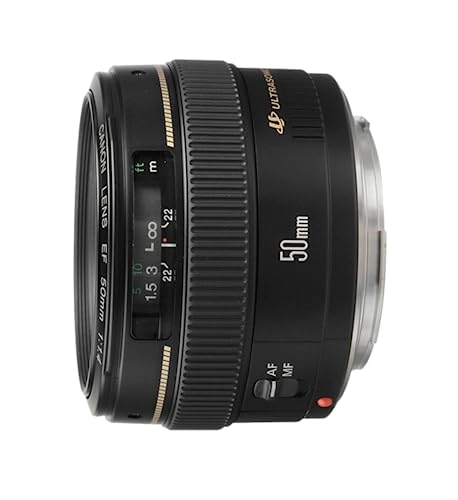
I know that this technically isn’t an APS-C lens but hear me out! The best portrait lenses are thought to be 85mm lenses with a maximum aperture of f/1.4 or higher. This is a 50mm lens on a full-frame camera, but it translates to an approximately 80mm lens on an APS-C Canon. If you want a lens specifically for portraits, this is easily the best option you can get.
Also, the aperture of Canon’s APS-C lenses maxes out at f/2.8, which just isn’t good enough for that dreamy bokeh. Sure, you can get great portraits with that aperture, but you can get even better photographs with the coveted aperture of f/1.4!
And I’m just getting started. This lens is designed for Canon’s range of full-frame cameras, so it’s higher quality than their standard APS-C lenses. It boasts an ultrasonic autofocus motor that is fast and silent, for perfect shots every single time. The closest focusing distance is 1.5 feet, but you might want to be further away from the subject if you’re using this on a crop sensor camera.
Additionally, if you upgrade to a full-frame camera anytime soon, you’ll have an excellent lens to get you started! Having a great full-frame lens means you can just grab the body of the camera and pair it with the lens you already have.
On top of all that, this lens weighs just a little over 10 ounces, so it’s great if you don’t want something heavy or bulky. It’s not the one all-purpose lens I would recommend for amateur photographers or travellers, but it is by far the single best lens Canon has to offer if your main focus is shooting portraits and people in general.
Pros
- Aperture of f/1.4 is perfect for portraits
- USM focus is smooth, silent and fast
- Compatible with full frame and cropped sensor cameras
Cons
- No built-in stabilization
- A full frame lens
Product Information
- Focal Length: 50mm = equivalent to 75mm on APS-C sensor
- Built-In Stabilization: No
- Weight: 10.2 ounces
Best $500+ Lenses
Canon EF-S 60mm f/2.8 Macro USM Fixed Lens

The 60mm f/2.8 is one of Canon’s first and best macro lenses for APS-C sensor cameras. It is able of capturing detail that is well beyond what the human eyes see, making it the best lens out there for people who like taking macro photographs.
The lens boasts Canon’s USM focus motor for silent and extremely fast focusing that gets you perfectly sharp photos every time. And the minimum focus distance for the lens is 0.65 ft, which is how you can get macro shots at a focal length of 60mm. Bear in mind that this is a fixed lens and that you can’t zoom in, so you will have to get physically close to the subject.
The maximum aperture of f/2.8 is great for this type of lens. Whether you want to photograph insects, flowers, animals, or just tiny objects, you will always get that perfect shot where the subject is entirely in focus with a smooth blur in the background. But you will need a steady hand since this lens does not have any built-in image stabilization.
You can even get some beautiful portraits with this macro lens! The aperture is more than suitable for creamy background bokeh, and the focal length is actually lower than what’s recommended for portrait lenses. You might want to switch to manual focus for portraits though, just to make sure that your subject is 100% in focus.
This lens weighs about 0.75 lbs, which is a bit heavy for a prime macro lens. But it’s not really a travel lens or something that you can use as an all-purpose lens, so I don’t think the weight actually matters.
This lens has a specific purpose, and I recommend it only to people who already own one or two well-rounded lenses and want something specifically for macro photography. If you want a versatile all-purpose lens, this is not the option for you.
Pros
- Okay for portraits
- Excellent macro lens for APS-C cameras
- USM focus motor is fast and silent
Cons
- No built-in image stabilization
- Not very versatile
Product Information
- Focal Length: 60mm
- Built-In Stabilization: No
- Weight: 0.74 lbs
Best $500+ Lenses
Canon EF-S 15-85mm f/3.5-5.6 Standard Zoom Lens
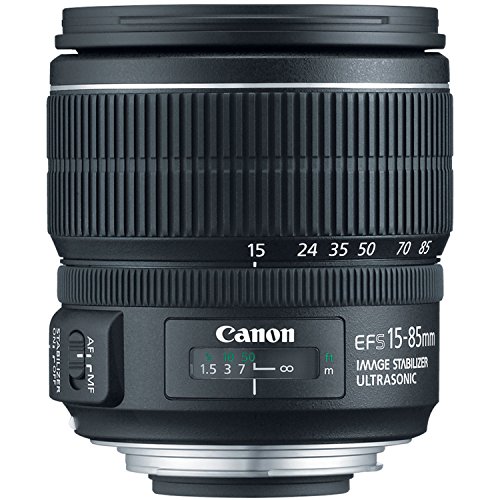
The 15-85mm lens is a great versatile lens for travel and street photography. It has built-in image stabilization so you can get sharp and focused shots on the go. It features a ring-type ultrasonic focus that performs very well and is regarded as higher quality than their stepper motor focus. The ultrasonic focus is faster, but also a bit louder so bear that in mind if you want to film videos.
This lens features a maximum aperture of f/3.5-5.6, which is pretty good. It’s not going to get you that silky smooth bokeh on portraits, but it is perfectly adequate for landscape and street photography. The closest focusing distance for this lens is 1.15 ft, so you can actually get some decent close-ups.
Although this lens is quite versatile, it’s not the best option if you want something that you can use to photograph objects that are very far away. But it is a great lens for snapping photos of subjects that are right in front of you – with a minimum focal length of 15mm, this is an excellent alternative to that standard 18-55mm kit lens.
The main downside of this particular Canon lens is the size. It is big, bulky, and quite heavy at nearly 1.3 lbs. If you were to mount this on your Canon camera, put it around your neck and then spend a couple of hours walking around town and photographing everything, I’m pretty sure you would start to hurt after some 30 minutes.
It’s a great lens but it’s far from the best or most convenient option for travel, particularly if you have to pay attention to the weight of your luggage. But then again, it is beginner-friendly, sharp, and features a fast and quiet zoom that makes it easy to get stunning photos without too much effort.
Pros
- Ultrasonic zoom is very fast
- Great for street and travel photography
- Not bad for portraits
Cons
- Heavy and bulky
- Not suitable for far away subjects
Product Information
- Focal Length: 15-85mm
- Built-In Stabilization: Yes
- Weight: 1.27 lbs
Canon EF-S 18-135mm f/3.5-5.6 IS Standard Zoom Lens

The 18-135mm telephoto lens is a great option if you want something well-rounded for travel. It has more range than a standard kit lens, especially when it comes to photographing objects that are far away. And with a maximum aperture of f/3.5 at 18mm focal length, you can get some good portraits as well!
This lens has built-in image stabilization, so it’s going to perform well in long exposure photographs. And it means you can snap photos on the go, without worrying that they will come out blurry or not in focus.
In fact, the focus motor on this lens is the main reason for the high price point with the NANO USM technology that combines the best of the stepper motor and the ultrasonic ring for a smooth, fast, and silent focusing experience.
It’s worth noting that this same lens is available in options with a stepper motor and with a micromotor, and both are cheaper than this one. But you should still get this one if you want the absolute best Canon has to offer.
One downside of that great focus motor is the weight. Other versions of this lens are up to 0.6 lbs lighter, which would make them more suitable for travel. At 1.6 lbs, this lens is a bulky beast that can make you uncomfortable after you’ve worn it around your neck for a while, so bear that in mind.
The extra weight is compensated with a focus that is four times faster and it’s up to you to decide which is more important.
Another advantage of the fast focus and great image stabilization is that this lens performs remarkably well when photographing sports and animals. You can zoom in on moving objects that are quite far away and have a sharp and focused photo of them in less than a second.
Pros
- Fast and silent NANO USM focus motor
- Focal range allows for wide angle and telephoto shots
- Dynamic image stabilization
Cons
- Quite heavy at 1.6 lbs
- Cheaper versions of the lens are available
Product Information
- Focal Length: 18-135mm
- Built-In Stabilization: Yes
- Weight: 1.6 lb
Canon EF-S 18-200mm f/3.5-5.6 IS Standard Zoom Lens

An 18-200mm lens is about as versatile as you can go for a camera with an APS-C sensor. Yes, there are lenses with telephoto zoom up to 250mm, but the focal range of those starts at 55mm as opposed to the 18mm of this one. Which means that this particular Canon APS-C lens can get you stunning wide-angle shots as well as let you zoom in on a subject that’s so far away you can barely discern it.
This is a great all-purpose lens and it’s worth every single penny. It performs well in virtually any scenario, whether you’re looking to shoot beautiful landscapes or zoom in on animals on a safari. The only area in which the lens underperforms is shooting portraits, due to the maximum aperture being f/3.5 at 18mm.
You can still get good-looking portraits, but the background blur might not be to your satisfaction.
The lens has built-in image stabilization for up to 4-stops, which can get you perfectly sharp photographs even at full zoom. And it boasts a micromotor focus that is quiet, fast, and much lighter than Canon’s other focus motors.
That’s another upside of this lens – it weighs just 1.3 lbs, which is pretty good for such a versatile lens. If you want a single well-rounded lens that you can take on your travels, this is easily the best option out there. It is not incredibly lightweight but it’s certainly much lighter than two separate lenses that will get you the same focal range.
One more thing worth noting is that the lens also has an option of a fast and smooth manual focus, for those scenarios when you want to be in full control of the camera. But I highly doubt you will get to use it too often, considering just how great the autofocus is.
Pros
- Best all-purpose lens for a Canon APS-C camera
- Not very heavy
- Image stabilization even at full zoom
Cons
- Not the best focus motor Canon makes
- Some aberrations at minimum zoom
Product Information
- Focal Length: 18-200mm
- Built-In Stabilization: Yes
- Weight: 1.31 lbs
What To Look For
Zoom Vs. Prime Lenses
I’ve included both zoom and prime lenses in this review, so what do you think is a better fit for your needs?
Zoom lenses are generally more versatile, especially if you grab something with an insane zoom range. One zoom lens can replace several prime lenses, so it’s much more convenient for travel. And of course, one of the main advantages of zoom lenses is built-in stabilization – a feature that you don’t see too often on prime lenses.
Additionally, zoom lenses are much more beginner-friendly, especially since most modern-day DSLRs have a convenient auto mode. Once you’ve mastered the zoom lens and gotten the hang of aperture, shutter speed, and different angles, you’re ready to try out a prime lens.
On the other hand, prime lenses are better for more experienced photographers. Some of the best prime lenses out there have a fixed aperture of f/0.95, which can get you some truly outstanding photos. If you want photos with beautiful bokeh, a prime lens will get you there faster than a zoom lens.
Another advantage of prime lenses is their portability. Although a single zoom lens is more versatile than two or even three prime lenses, there’s the size factor. Zoom lenses can be ridiculously big and heavy, while prime lenses are usually small and lightweight. A versatile 70-200 mm zoom lens will eventually hurt your neck, so is it really worth the versatility?
What’s Your Budget?
Lenses are expensive and having a defined budget will greatly help you find the best lens for you. It might not be easy to find the exact type of lens you want in that budget, but it is possible. And it’s better to know your budget and stick to only looking at lenses that you can afford, than to pine over professional lenses that are more expensive than your entire camera.
It’s worth noting that prime lenses are generally cheaper than zoom lenses – if you’re on a tighter budget, it’s not a bad idea to pick up a couple of primes. Especially since they can get you better-looking photos than zoom lenses if you know how to use them to get those perfect shots.
Another thing I would like to point out is that you don’t necessarily have to get a Canon lens if you have a Canon camera. You can find options from third-party brands that are two or three times cheaper, and it’s a good idea to at least check out the various options you have. If you see a lens you love but you can’t afford it, check out what Sigma, Tokina, and others have in the same category.
Last but not least, don’t rule out buying used lenses. This is a great way to save money, and often you’re getting a lens that’s pretty much brand new. Many people take good care of their cameras and lenses because they have the intention of reselling them. And honestly, it’s rather difficult to break a lens.
Unless you’re purposefully violent with it, there are really not that many components that can get broken are damaged during prolonged use.
Aperture And Focus Motor
Several of the lenses featured here are available in cheaper versions. They have the same focal length but feature either a different focus motor or a lower maximum aperture. That’s what makes them cheaper and it’s important to know what exactly you are sacrificing if you decide to buy the more affordable option.
Canon has two main focus motors that they use in their lenses – STM and USM. STM is a stepper motor that is generally preferred by beginners. It is quite fast and silent, and it is a great focus motor if you want to shoot videos. This is their most silent motor and camera microphones are unlikely to pick it up.
USM is an ultrasonic motor ring that is several times faster than the STM, but it’s not quite as silent. Your camera microphone will pick it up, so it’s not the best option for shooting videos. But if you want to take photos of wild animals or athletes in action, definitely grab a lens with this focus motor because it will get you a perfectly sharp photo every time.
When it comes to aperture, it’s important to note that Canon doesn’t make any native APS-C lenses with an aperture of f/1.4. The maximum they have for their cropped sensor camera is f/2.8 – it’s good, but it’s not the dream.
The good news is that you can put any of their full-frame EF lenses on an APS-C camera, but you have to account for the crop factor. Just multiply the focal length by 1.5 and you’ll get an idea of what the lens performs like on an APS-C sensor camera.
Higher apertures get you smooth background blur (bokeh) and are generally preferred for portraits. Lower apertures are okay for shooting landscapes and buildings, but I would recommend that you always go for the highest aperture you can. It’s just more versatile, and it’s the better option in the long run.
Most of the mid-range lenses will have an option of f/3.5 or f/4 as the max aperture, and I would always recommend the former. The price difference is never that big, but the difference in performance is certainly noticeable.
Best APS-C Lenses For Canon Cameras: Our Top Picks
Not sure which lens to get for your Canon camera? Go with one of our top three picks, depending on your budget and the type of lens you want!
If you’re looking for the best value for money, grab the two-lens kit. It includes a 10-18mm wide-angle lens and a 50mm f/1.8 prime lens. The zoom lens is excellent for street photography and landscapes, while the prime lens dominates portraits.
The prime lens is a full-frame option though, but it is perfectly compatible with APS-C cameras! It is a 75mm lens on a crop factor camera, but it still offers the same maximum aperture.
- EF 50mm f/1.8 STM is a compact, lightweight fixed focal length lens ideal for everyday photos, and with a large f/1.8 aperture, a perfect lens for low-light photography and creative background blur
- EF-S10-18mm F4.5-5.6 IS STM is an EF-S ultra-wide zoom lens with an impressive starting focal length (16mm in 35mm equivalence). For expansive scenery from tall buildings to inspiring mountain ranges, the wide angle of view from the EF-S 10–18mm f/4.5–5.6 IS STM helps you achieve vivid colors and details during your travels
In case you want a versatile lens that will cover all your needs, I recommend the 18-200mm option. It’s great for everything from shooting wide-angle landscape photos to zooming on subjects that are very far away. This lens boasts built-in image stabilization and a micromotor focus motor that is smooth, silent, and fast.
- Versatile 18-200mm zoom lens for APS-C Canon EF-S-mount cameras (28.8-320mm equivalent)
- Optical Image Stabilizer reduces camera shake by up to four stops
And if you want a versatile lens but you’re on a tighter budget, go with the 55-250mm one. It has built-in image stabilization for sharp shots on the go, and it boasts Canon’s stepper motor focus that is super silent. This affordable lens is extremely versatile, and if you already have that kit 18-55mm lens, it will cover all your needs!
- High magnification, compact and lightweight EF-S telephoto zoom lens with Image Stabilization for up to 3.5 equivalent stops of shake correction. Based on CIPA (Camera & Imaging Products Association) standards. Testing performed using EOS 7D at focal length of 250 millimeter (400 millimeter in 35 millimeter equivalence).
- One UD lens element reduces chromatic aberration throughout the zoom range, for excellent image quality with high resolution and contrast.
Head over to Amazon to see the exact prices of all of the lenses featured here and to check if you can get renewed options cheaper.
