
Best Snowshoes For Beginners (Enjoy The Snow)
If you want to learn to snowshoe you are obviously going to need a pair of snowshoes. And in this post, I will show you a few great beginner models that also don’t cost an arm and a leg.
Below are some of the best snowshoes for beginners on the market along with enough details to help you make a decision.
Top Product Overview
 |
| SEE ON MSR →SEE ON AMAZON → |
 |
| SEE ON AMAZON → |
 |
| SEE ON AMAZON → |
Top Products
MSR EVO
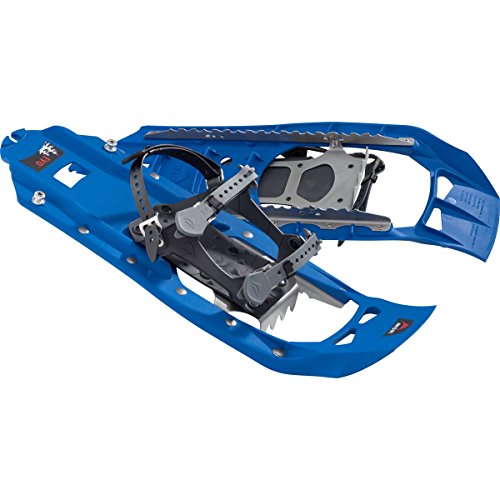
The MSR Evo is a classic in the snowshoe industry and for a reason.
These snowshoes are simple, solid, and work like a charm.
I have had a pair for about 4 years, and even though I am no longer a beginner, they still serve me well in a huge variety of terrain in the Swiss Alps where I live (hardpack, ice, powder, etc).
The one huge difference with these snowshoes is that they are light. You will appreciate that after hours on the trail.
Their crampon system is also top-notch with full length crampon rails as well as nice long crampon teeth on the toes. I rarely have a problem getting grip and the only reason I ever slide is that the snow compresses (something you can’t do anything about).
The securing system of straps is a bit of a pain to get on (they are stretchy rubber straps you have to hook onto a metal tooth) but once you get the hang of it, it only takes a few minutes to get secured. The main benefit of this system is you can fit almost any height/width or type of shoe in them. You just have to align your foot right before you tighten them.
Other things to note: the cheapest version of this model does not come with a bag, but I recommend you get the one that does. It’s worth it (I bought mine years later).
If you live in an area with a lot of deep powder it is also worth getting the tail extension because these shoes won’t keep you afloat so well in such conditions (so far I have had no issue in Switzerland, but we don’t get huge dumps).
Pros
- Flexible foot securing fits almost any size/length
- Full length crampon and long toe crampon gives exceptional grip
- Lightweight plastic design
Cons
- Needs extension to work well in powder
- Foot securing is a bit fiddly
- Plastic body
Product Information
- Weight: 3 lbs 9 oz (1.63 kg)
- Crampons: Steel full length side rails, Steel toe
- Foot Securing System: Elastic rubber staps (2 across foot, 1 on heel), Fits almost any size and shape footwear
- Body Material: Plastic
- Bag: No (Can buy in a set)
Chinook Trekker
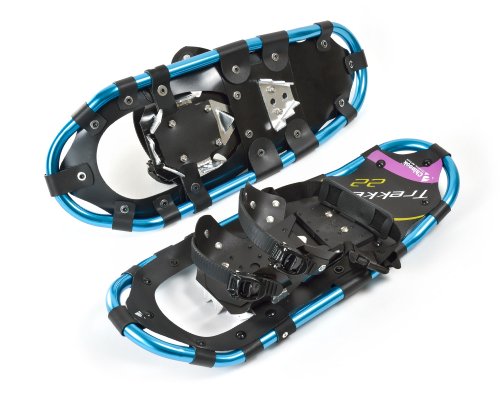
The Chinook Trekkers are the snowshoes you want to choose if you are on a budget.
They are the cheapest of the three models in this review, but still offer you all the things you need to start snowshoeing this season.
They have a very solid construction with an aluminum tube frame with a polyethylene cover. They are not as light as the Evos above, but still not bad.
What I really like about the Trekkers is their foot securing system. If you have used rollerblades or snowboarded, you will too. It’s a simple ratchet system that allows you to quickly and easily tighten the straps to your size. And releasing is a cinch. Just press the button. The only downside of such a system is that it could break. Unlike the Evos which just have a rubber strap.
The grip you get with these snowshoes is not as great as the other models because you only get a foot and heel crampon system. However, it should be more than decent for most conditions.
All in all, these snowshoes are a decent buy for a beginner and if you love it after a season or two, you can easily upgrade without having spent a fortune!
Pros
- Easy foot securing with ratchet system
- Budget friendly price
Cons
- No full-length crampon
- Not the lightest model
Product Information
- Weight: 4.3 lb (1.95 kg)
- Crampons: Aluminium foot and heel
- Foot Securing System: Ratchet system (two across foot), Simple strap on heel
- Body Material: Aluminium frame, UV resistant polyethylene decking
- Bag: Yes
Louis Garneau Boreal
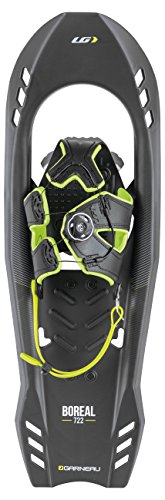
Louis Garneau make a huge range of snowshoes and one of their entry level models, the Boreal is a great beginner snowshoe.
The best thing about the Boreal showshoe is the simple foot securing system. It is a single dial that locks down the foot in seconds. My only concern is that this will not last in the harsh conditions you find snowshoeing, but having said that, a lot of snowboarding gear uses the same system, so maybe I am wrong.
The body of the snowshoe, like the MSR Evo, is fully plastic, but surprisingly this model is still as heavy as the Chinook above.
The crampons are a bit better than the Chinook though with half length rails, a heel crampon as well as nice deep teeth on the toes.
Overall, if you want a decent snowshoe that are super simple to get on, this might be the model for you.
Pros
- Simplest foot securing system around
- Decent crampons
Cons
- Plastic body (but not the lightest)
Product Information
- Weight: 4.25 lb (1.93 kg)
- Crampons: Steel half length side rails, Steel toe, Steel heel
- Foot Securing System: Single Boa closure system, A simple dial closure on foot, Single rubber strap on heel
- Body Material: Plastic
- Bag: No
Choosing Your First Snowshoes
The first thing to understand is that snowshoes are actually pretty simple. So, there are only a few things you need to consider. I will go over each below.
Weight
It might not seem a big deal, but when you drag these things around all day you will start to care.
Quite simply, the lighter the better.
My first few times out I got sore hip joints (maybe it was just me) from dragging these around all day.
Crampons
They all do a reasonable job, but the more potential grip you have the better.
The crampons are basically metal teeth that help you get traction as you climb. On flat it’s not such an issue, but as soon as you hit a hill, even just one or two steps, you will appreciate good, long crampons and nice bite on the toes as you struggle to get a hold in more difficult terrain.
Foot Securing System
This is only a big deal when you are putting the snowshoes on, but worth thinking about. Some are simple, others take more work (like the MSR Evo).
But once they are on, the other two points above are far more critical as they affect you 99% of the time on the snow.
Which Is The Best Beginners Snowshoe?
In my experience, you can’t go past the MSR Evo. They are a powerhouse in almost any condition. Both mine and my girlfriends have lastest for years (her’s for almost a decade) with constant use in winter. They are lightweight (which is important) and grip in almost any condition.
The only downside is the securing system is a bit of a pain to get on. We still take a few minutes even with practice. But, once you are going, if you have pulled them tight, they never come off. Ever. You also have to align your foot in them in the beginning so you walk straight in the shoes (as they are quite roomy – for any shoe – so don’t guide your foot in straight.
- Dependable, durable all-condition snowshoes offer excellent traction and floatation on snowy trails and rolling terrain
- Steel traction rails and brake bars are molded into snowshoe decking, and along with carbon steel crampons, provide secure grip in tricky conditions
If you just want to get the cheapest around, it is more than likely the Chinooks will be the way to go. Although check the other models here as there are sometimes sales.
- Light weight and strong aluminum frame features an ergonomic design to ensure comfortable and easy walks
- UV resistant polyethylene decking, easy-to-use dual ratchet bindings and heel straps with quick release buckles
The Boreals is also a good buy with the simplest securing system (one dial) and decent materials and crampons to get you going in almost any condition.
- Day Hiking Performance snowshoe for all terrain outings
- V-Rail crampon system molded into the deck provides maximum traction uphill, traverse and downhill
Just keep in mind that these are entry-level snowshoes, and if you get more serious you might want to upgrade. Although, I have snowshoed for years on the MSR Evo and the only thing I would add is a tail for deeper/powder snow (we just don’t need them very often here).
Now go get out there and enjoy the snow! it’s awesome :>
