
Kelty Redwing 50 vs. Osprey Farpoint 55: Which Backpack Should You Get?
PRODUCT COMPARISON

Kelty Redwing 50
The Redwing 50 is a long-time best-selling backpack from Kelty. It’s designed with hikers and campers in mind, and it has all the features you need to take on both the urban and the literal jungle.- Dimensions: 27” x 18” x 10”
- Weight: 3.9 lbs
- Capacity: 50 liters
- Torso Fit Range: 15.5” – 21”
- Body Fabric: Poly 420D Small Back Stafford
- Frame Material: Spring Steel + HDPE

Osprey Farpoint 55
The Farpoint 55 is one of Osprey’s most popular travel backpacks. It’s an amazing carry-on backpack for travel, but it’s also a decent option for other outdoor adventures.- Dimensions: 25" x 13" x 13" (with detachable daypack)
- Weight: 4.2 lbs
- Capacity: 55 liters
- Torso Fit Range: 15” – 22”
- Body Fabric: 450D Recycled Twist Dobby Polyester
- Frame Material: Lightwire alloy peripheral frame
Not sure if you should get the Kelty Redwing 50 or the Osprey Farpoint 55? Then you are definitely in the right place because this detailed comparison will help you decide between the two backpacks!
They don’t look very similar at first glance, but once you start examining their features you notice that the two bags have a lot of things in common. They’re both best-selling backpacks made from premium materials and with some truly excellent features. But they’re each best suited for different adventures, so keep reading to see which bag fits your needs best!
Kelty Redwing 50 Vs. Osprey Farpoint 55: Shared Features
It’s so hard to decide between these two backpacks because they are so similar! Below is a detailed account of all the features that are either identical or very similar on the Redwing and Farpoint backpacks.
Materials And Durability

Both these backpacks are made from high-quality materials and boast excellent durability. They’re not manufactured from identical fabric, but both backpacks are made from durable polyester.
The material performance and features are extremely similar, so it shouldn’t be important when deciding which backpack to buy.
Osprey Farpoint 55 is made of slightly denser polyester, but the difference is barely noticeable. Both backpacks are water-resistant, durable, and easy to keep clean. The material is also tear-resistant and it would take a lot of abuse to make a hole in one of these packs.
Comfortable Back System

Another thing these two backpacks have in common is a very comfortable back system. If you’re wondering if one of these backpacks going to be more comfortable or easier to carry when filled, the answer is no. They’re both equally comfortable to wear, despite the fact they don’t feature identical back systems.
On both these backpacks, you get a back panel that’s padded and covered with breathable mesh for excellent airflow. Both packs are also equipped with padded shoulder straps, a convenient sternum strap, and a padded hip belt that helps transfer the load onto your hips.
Great Organizational Features

Although the two bags differ slightly in size and capacity, they both have excellent organizational features. The Redwing 50 and the Farpoint 55 feature multiple compartments, with a variety of smaller pockets in the bag.
You get external pockets on both these packs as well. The Redwing backpack features standard stretchy side pockets, while the Farpoint 55 has those same pockets but on the detachable daypack.
The Redwing 50 features multiple top-loading compartments with smaller pockets and organizational panels. The Osprey backpack doesn’t have quite as many pockets or sleeves in the main bag body, but it makes up for that with the variety of internal and external pockets in the smaller detachable daypack.
Versatility
Both these backpacks are highly versatile and you can use them for different adventures. Although they’re each better suited for a specific activity, the excellent build quality and great organizational features mean you can get away with using them for a variety of things.
So, even though the Farpoint 55 is obviously a travel backpack, its comfortable back system, detachable daypack, and roomy capacity make it perfectly suitable for the exploration of more rugged surroundings. It’s a decent backpack for campers and hikers, especially if you’re all about multi-day adventures and you need plenty of storage in a bag.
The Redwing 50 is an excellent bag for hikers, but its generous capacity and excellent organizational features make it a great option for travel as well. It’s too big to pass as a carry-on, but it makes for a decent checked bag.
Compression Straps

Another features these two bags share is the presence of many compression straps. Each of these backpacks is equipped with four compression straps, but their distribution isn’t quite identical.
Kelty Redwing features four external compression straps, two on each side. This is the standard placement for compression straps on a hiking backpack. They’re great for controlling the shape of the bag when it’s not full, but also for storing some bulkier items in the side pockets.
You can store tripods and even hiking poles in the side pockets of the Kelty Redwing 50, and you can secure them in place with the side compression straps!
The Osprey Backpack also features four compression straps – two internal and two external. The external compression straps are in the front and great for cinching in the backpack when it’s not filled to capacity. Also, the front compression straps help keep the daypack in place when it’s attached to the main chassis of the Farpoint.
The internal compression straps are extremely similar to the tie-down straps you’d get in a suitcase. Their main purpose is to keep the contents of the backpack secure so that even if you have to open the bag up to get something, you don’t have to lie it flat to avoid spilling all of its contents.
External Gear Attachment Loops

Both backpacks are equipped with external gear attachment loops, which are extremely convenient for any bulkier items that don’t fit inside the bags. You just need a carabiner, and you can attach pretty much anything you want to the exterior of these packs.
The Kelty Redwing has proper daisy chain webbing on the front panel and sleeping pad loops at the bottom. The Osprey backpack doesn’t have daisy webbing, but it does feature multiple attachment loops on its exterior.
You’ll also get gear attachment loops on the shoulder straps of these backpacks – whether you want to use them for bulky gear or just to store your sunglasses is entirely up to you.
Kelty Redwing 50 Vs. Osprey Farpoint 55: The Differences
Although these two backpacks are very similar in size and build quality, they’re made for different adventures. Kelty Redwing 50 is an excellent backpack for hikers and campers, while the Farpoint 55 has more travel-oriented features. Keep reading to find out more.
Size, Capacity, And Main Compartment Opening

The most obvious difference between these two backpacks is their size. Farpoint 55 is the bigger of the two, which is evident from its very name. It’s got a bigger capacity than the Redwing pack, but the difference is only 5 liters.
Interestingly, the Farpoint isn’t the bigger of the two backpacks. It owes most of its extra capacity to the detachable daypack and without it, this bag actually has a smaller capacity than the Kelty Redwing.
The Redwing is taller and wider than the Osprey bag, but the Farpoint is deeper – again, because of the attached daypack. Five liters isn’t a massive difference in capacity, especially for hikers and outdoor adventurers.
However, if you are primarily looking for a travel bag, then the Osprey bag is definitely the better option for you. It is several inches shorter than the Kelty backpack, so it’s going to be much easier to travel with it. Without the daypack and with the help of the external compression straps, the Farpoint 55 should easily pass as a carry-on item.
Another important difference between these two bags is the opening of the main compartment. The Redwing 50 features a classic top-loading main compartment, which is usually seen in backpacks for hiking and other outdoor adventures. It’s nothing new and it’s perfectly convenient, especially for grabbing things on the go.
The Osprey Farpoint 55 is more oriented toward travelers, and this is also evident from its main compartment. It’s a front-loading compartment that opens up fully, so you can easily access everything inside the bag once you unzip it. The main advantage of this style of the main compartment is that packing for trips is super easy. The downside is that grabbing things on the go isn’t quite as convenient.
Farpoint 55 Detachable Daypack

Osprey Farpoint 55 has a detachable daypack in the front and it’s one of its best features. The daypack is great for both campers and travelers – you can keep all the bulkier items inside the main bag, and then use the daypack for all those things you want more easily accessible.
Whether you’re staying at a campsite and you want to go on a quick hike but you don’t want to carry the entire Farpoint with your, or you’re at the airport and you need a smaller bag that can fit all your most important belongings.
It’s also worth noting that the detachable daypack is small enough to fit under most airplane seats, while the main bag body comfortably fits in the overhead bins. There’s a laptop compartment inside the smaller pack, as well as various other pockets to keep all your in-flight necessities neatly organized.
Farpoint 55 Stowable Shoulder Straps

The shoulder straps on the Osprey backpack can be hidden away, which is another unique feature. Again, this is another travel-oriented feature that makes the Farpoint 55 a great option for a travel backpack. Stow away the shoulder straps when it’s time to store the backpack in the overhead bin – it’s much easier to do so with a smooth back of the bag!
Redwing 50: More Pockets

The one thing that the Redwing 50 Backpack does better than the Osprey Farpoint is the number of pockets. This backpack has so many pockets that you can easily find a dedicated spot for every single item you want to put in the bag.
There are two pockets on each side, an extra pocket at the top, and another pocket on the front panel. You’ll also get an organizer panel in the Redwing 50, with several smaller pockets so you can easily keep all your necessities organized.
Price Point
There’s a major difference in the price points of these two backpacks, so it’s going to be a no-brainer if you’re on a tighter budget.
The Kelty Redwing retails for around $150, and it’s the cheaper of the two backpacks. It’s worth noting that you can often find it discounted at various retailers and if you wait for a bigger sale, you can save some serious money on this backpack.
The Osprey Farpoint 55 is more expensive. It normally retails for around $220, and it’s not discounted as often as the Redwing 50. However, it’s important to point out that, with the Osprey bag, you are getting two backpacks for the price of one. So, even though it’s the more expensive bag, the value for money is practically the same since you’re getting more bang for your buck.
Kelty Redwing 50 Vs. Osprey Farpoint 55: What To Choose?
Kelty Redwing 50 and Osprey Farpoint 55 are both two excellent large-capacity backpacks. They’re very similar when it comes to the build and material quality, as well as carrying comfort. Both backpacks also have a very generous capacity, but the Farpoint is about 10% bigger than the Redwing.
The Redwing Backpack is the better option if you’re looking for the ultimate hiking companion. It’s an amazing outdoor backpack with lots of features that will make your life easier during multi-day hikes. It’s also a good backpack for travel, but the large size means it will rarely pass as a carry-on item.

- Redwing is a tried & true trail value for all day hikes or a quick overnight, a true multipurpose pack from international travel to a day on the trail
- Perfect Fit Suspension supplies you w/ customized comfort without the hassle, accurate on body adjustments w/ 3 simple steps for pack fitting success
The Osprey Farpoint Backpack, on the other hand, is the perfect carry-on size without its detached daypack. In fact, the chassis takes advantage of the maximum dimensions for an in-cabin bag, while the detachable daypack fits perfectly under airplane seats.
The stowable harness, front-loading main compartment, and internal compression straps are all features that will make your life easier while traveling.
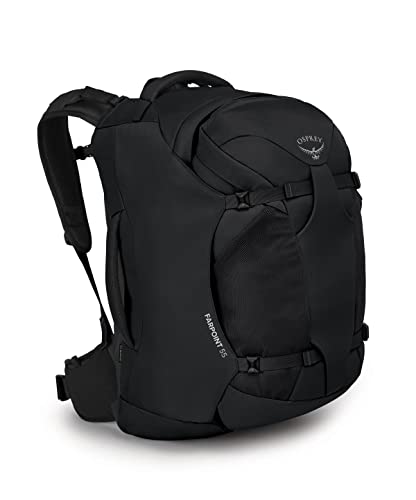
- Lightweight & Durable - Durable fabrics in high-wear areas combine with smart design to create a lightweight and tough travel pack that will last a lifetime.
- Stowaway Harness & Hipbelt - The harness stows away for safekeeping while checked and deploys quickly for any path or trail.
So, if you want a backpack for hiking and camping, get the Kelty Redwing 50. But if you want a great backpack for travel, go with the Osprey Farpoint 55.
If you’re on a tighter budget, the Redwing 50 is the better option because it’s about $70 cheaper than the Farpoint. But if you want more value for money, stick with Osprey – you get two backpacks for the price of one!
Head over to Amazon to see more photos and the exact prices of the backpacks featured in this detailed comparison. Check out our related posts for ideas on other large-capacity backpacks!
RELATED POSTS:
