
Last Updated: December 16, 2021
Famous Landmarks In Poland
Poland is a stunning country that isn’t on many people’s fly-to bucket list. It seems to have been missed out for some reason but it’s actually a fantastic country that everyone should see and a great way of seeing it is by checking out the famous landmarks in Poland.
Poland’s landmarks are extremely diverse, and one of the many reasons Poland is famous. They pretty much have it all from sites related to two World Wars, to national parks and mountains, beautiful pieces of architecture, museums, and lots more.
Join me as we take a dive into the amazing landmarks that you have to see while you’re in Poland.
Table Of Contents
Show All
Malbork Castle
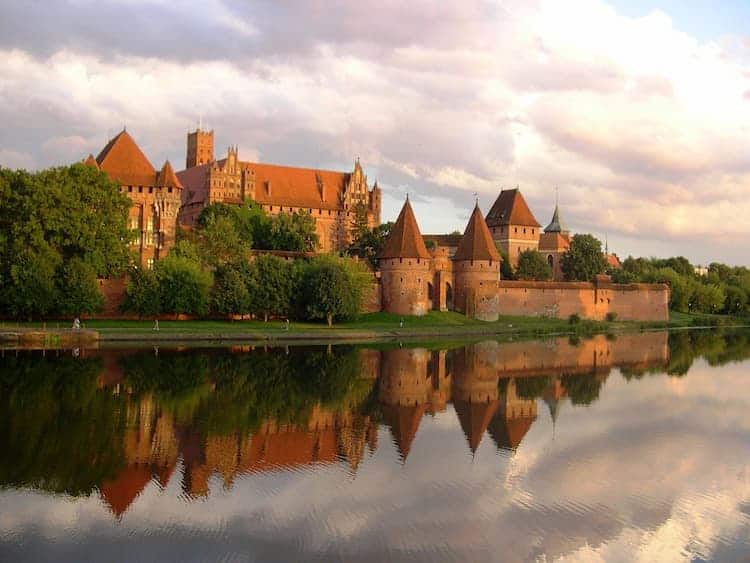
Malbork Castle is the largest castle in the world and you’ll find it in northern Poland close to the town of Gdańsk. Malbork Castle is a UNESCO World Heritage Site and one of the famous landmarks in Poland that is a must-see.
Construction started on Malbork Castle in the late 1200s and it took a while to build as it had to be done in stages, which is no surprise since it’s the largest castle in the world. The magnificent building was first owned by a group of German Catholic crusaders called the Teutonic Knights who invaded Poland and took over the area.
The Teutonic Order called the castle “Marienburg” after Mary mother of Christ and as time passed, the castle slowly got larger and changed owners too. First, the Polish Royalty took over, and then the Germans took it back, and it was finally returned to Poland after World War II.
The Malbork Castle is stunning to see and is a prime example of Gothic architecture. When you first see the castle, you’ll immediately notice the gothic architectural style and its glow of faded red brick somehow draws you in.
The castle is divided into 3 sections, lower, middle, and higher divided by dry moats and Gothic towers. It will take you around 3 hours to visit it properly and you could easily spend the whole day there.
Getting to the castle is easy as you can get a direct train to Malbork from both Warsaw and Gdańsk and then it’s a 20-minute walk to the castle. Be sure to book in advance as it’s a very popular tourist attraction.
Wieliczka Salt Mine
The first famous landmark in Poland we are going to look at is the Wieliczka Salt Mine located just outside of Krakow, in the small village of Wieliczka in southern Poland.
The Wieliczka Salt Mine is a registered monument in Poland as it was a large part of Poland’s history. The Wieliczka Salt Mine started out in the 13th century and the mine produced rock salt all the way up to 2007, that’s almost 800 years of salt production!
Nowadays, the mine is one of the most popular tourist attractions in the country, so much so that booking in advance to see it is a wise move. When you visit the mine you’ll be able to go down into the shafts and tunnels of the mine where you’ll find an underground lake and lots of various chambers, one of which is the beautiful St Kinga’s Chapel.
You’ll also get the opportunity to learn about the history of how mining shaped the town, about the machines and tools used for the mining, and the olden day salt extraction methods. It’s a great eye-opener to how tough life was for miners and how the techniques have evolved so much.
Getting to the mine is easy from Krakow as there are direct buses and trains to the mine. If you have a car then you can drive there in less than 30 minutes.
Fountain of Neptune in Gdansk
The Fountain of Neptune is in the middle of the Długi Targ market square in Gdansk and is a landmark worth seeing while you’re in the area.
The Fountain is surrounded by beautiful historical buildings and while the impressive buildings try to steal the show, it’s the Fountain that’s the real hero. It’s been sitting there since 1633 and has become a symbol of the city.
The statue of Neptune throwing his trident towards the ground is made from bronze and was created by a Flemish artist in 1549. It was then converted into a fountain later on as legend has it that Neptune got annoyed with people throwing gold into his fountain and asking for financial gain. Eventually, he lost it and fired his trident into the ground, breaking the gold into tiny pieces.
Sitting in the square and staring at the fountain and historic buildings is a wonderful way to watch the world go by. It’s best to be there early to avoid any crowds and enjoy some peace with the lovely surroundings.
Warsaw Rising Museum, Warsaw
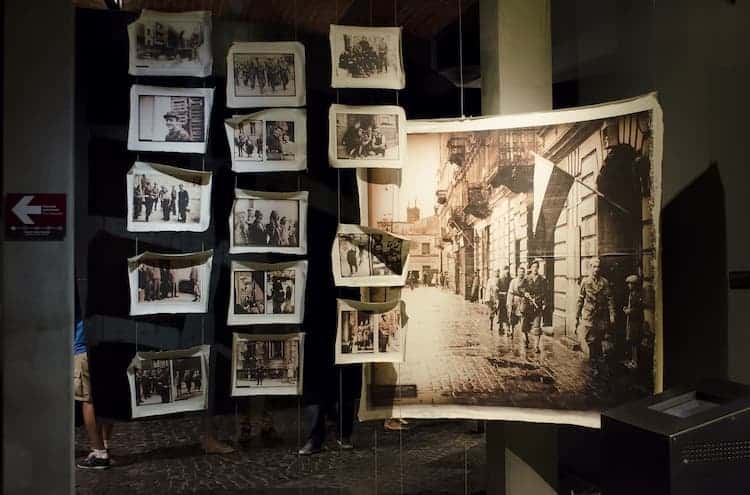
The Warsaw Rising Museum is a museum dedicated to when the Polish Underground Resistance fought the German occupation of Poland’s capital city in 1944 during World War II.
The fight was large, lasted for two months, and it resulted in a huge amount of deaths for both parties. At one point in the conflict, the Polish citizens had the Germans surrounded and this is when the Germans retaliated by blowing up a lot of historical buildings in Warsaw.
The museum has done an amazing job at recreating the spirit of the Resistance and it’s unfortunate that they lost the battle for Warsaw. While in the museum you’ll find exhibitions in a film that bring the event back to life as well as interactive displays and models such as the sewers used to move around the city undetected.
You’ll even find a replica hospital and printing shop with newspapers and posters from the time on the show. There is also a section that is just about the German’s atrocities and their occupation.
Visiting the Warsaw Rising Museum is quite an experience and it is really well exhibited. Be prepared for a rather emotional experience and I’d recommend going there early on your visit so you can walk around the city with it in the back of your mind.
Warsaw Old Market Place, Warsaw
The Warsaw Old Market Place is the main market square in Warsaw’s old town city center and the area dates back to the 1200s.
It’s one of the most beautiful parts of Warsaw and fantastic to wander around especially as you have the Royal Castle where Polish Kings sat at one end of the Old Town, and the Warsaw Barbican at the other which was designed as an entrance gate.
While there are some beautiful historical buildings to see in this historic center, most of them were destroyed by the Germans but were restored to exactly how they were to their former glory after the war. The buildings feature a mixture of Gothic and Renaissance styles and they are stunningly beautiful.
In the middle of the square, you’ll find a bronze statue of a mermaid wielding a sword that was built in the 1800s. It managed to survive the war and has been a symbol of the city for centuries.
The Old Town of Warsaw was constructed in the 13th century when Warsaw wasn’t the capital. It became the capital in the 1600s when King Sigmund moved his residence to the Royal Castle and since then all the Polish Monarchs have lived in the Royal Castle.
Today, the Old Market Square is a delightful place where you can enjoy great food and coffee that the many restaurants and take in some Gothic architecture and Renaissance architecture. You’ll also find the Historical Museum of Warsaw in the square where you can learn about the history of Poland, Warsaw, and see a huge collection of renaissance art and contemporary art.
Castle Lancut
Lancut Castle is another fantastic building one should see, especially if you’re already in the southeast of Poland. You’ll find it a few km to the east of the large town of Rzeszow.
The castle was built by an aristocratic family who employed an architect to make a stunning but secure and safe castle that they could enjoy living in but be protected when needed.
The castle sits on a large estate and is surrounded by beautiful gardens as well as nervous buildings and features including carriage houses, a guest house, greenhouses, tennis courts, and a pond.
The castle building is quite spectacular and it features a renaissance style to it and it’s also home to a large collection of renaissance art too.
One thing that is a must-see at the castle are the old carriages that are kept in the stables. You’ll see the oldest carriage in Poland along with loads more that feature lots of different styles and span a few centuries too.
While walking around the inside of the castle you’ll see a magical ballroom, sitting rooms, and lots more, each of which is decorated with furniture from specific times.
Lazienki Park, Warsaw
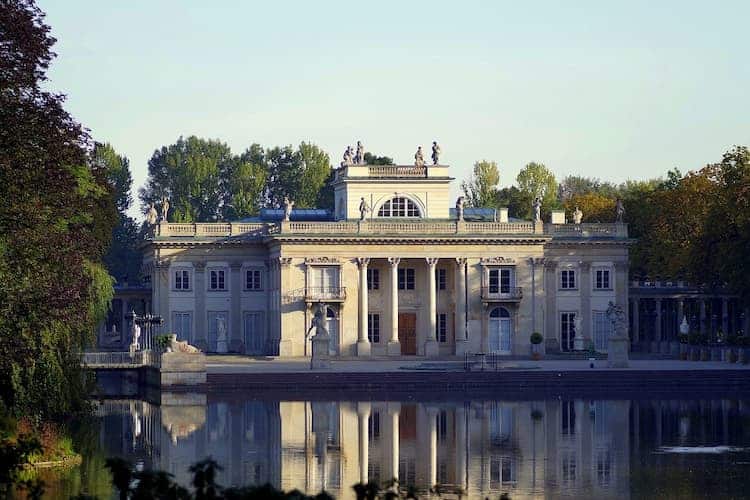
Lazienki Park sits in the heart of Warsaw and as parks go, this one is pretty special. The park was first created as a baths park in the 17th century and was a place where the noblemen used to bathe and today it’s a 76-hectare park that is for all to use.
Lazienki Park, while being one of the biggest urban parks in Poland, is also home to some stunning buildings such as the Palace on the Isle, the Royal Łazienki Museum, Museum of Hunting and Horsemanship, as well as loads of national monuments too.
The surrounding park is full of stunning gardens, lakes, ponds, and canals. If there is one palace you can find some peace, quiet, and a dash of history in Warsaw, Lazienki Park is it.
The Palace On the Isle was a Royal summer palace and was built in the 18th century. It has its own set of stunning gardens, an orangery, some amazingly decorated rooms, plus an old art collection. It’s called Palace On The Isle because it sits on an island in a lake and is famous for having a theatre stage where performances still happen today.
You’ll also find a string of other museums and galleries in the park along with a statue of Frederic Chopin, the Polish composer, and a temple dedicated to the classicist goddess Diana.
I highly recommend visiting Lazienki Park on a Sunday afternoon where you’ll find free piano concerts taking place at the bottom of the Frederic Chopin statue.
Wolf’s Lair, Gierloz
Wolf’s Lair is a historical site everyone should visit as it was Hitler’s top-secret headquarters during the war. It sits in northeast Poland in the Masurian woods and can be visited on a day trip from Warsaw or Gdansk, but it’s a lot closer to Gdansk.
When Wolf’s Lair was being used during the war it was heavily defended. There were three security areas around the site which included heavily armed military units as well as areas filled with landmines.
Wolf’s Lair used to consist of a lot of buildings, some 80 or more and it had everything it needed to be Hitler’s HQ. There were look-out towers, bunkers, air-raid shelters, and lots more.
When the Soviets invaded to flush out the Germans in 1945, the Nazis blew up Wolf’s Lair to remove the evidence but a lot of the buildings were not destroyed.
Visiting Wolf’s Lair is more of a walk around the site than anything else but it holds quite a serious energy, especially if you remember what happened there some 80 years ago. There are plans to add a museum or an exhibition center there in the future.
National Stadium in Warsaw
Warsaw’s National Stadium was built for the 2012 European Football Championship when Ukraine and Poland were the hosts. The building started in 2008 and it was completed just in time in 2011.
It was built to the highest UEFA standards and can seat a huge 58,580 people, 1,765 cars can park there, it has a retractable roof, 965 toilets, a fitness club, multi-faith chapel, and 4 restaurants.
Before it was built, the site was the home to the 10th-Anniversary Stadium which was built in the 50s and was the top stadium in Poland until the 80s when it slowly stopped being used as a stadium and became one of the largest markets in Europe called Jarmark Europa. The market was a hub for illegal imports including booze, cigs, software, and even weapons.
Today, the National Stadium is a new world compared to the market and it hosts football games, as well as many other events.
In 2014, a load of fans and a huge swimming pool were added for a windsurfing competition, artists like Coldplay have played concerts there, and it’s also home to the largest business center in Warsaw. In winter, the stadium turns into an ice rink for the public.
The special thing about the National Stadium is the facade which features the national colors of Poland and looks like a red and white flag moving in the wind.
Centennial Hall
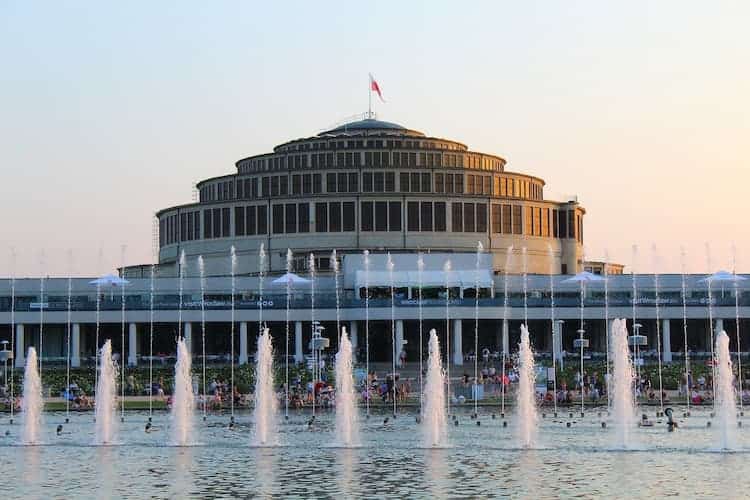
The Centennial Hall sits in Wroclaw old town, a city in the southern part of the country. The hall is listed as one of the official National Historical Moments of Poland and the building commenced in 1911 using the architectural designs of Max Berg and was completed in 1913. This all while Warsaw was still a part of the German Empire.
Built from reinforced concrete it’s a famous building in the world of concrete architecture and engineering and maybe reinforced concrete structures have been inspired by it since.
It was built as a recreational building and in the middle of the hall is a larger circular space that today is used for concerts and can seat an amazing 6000 people. The concert space converges to a huge 23-meter dome which is covered in a roof made from glass and steel. When lit up at night, it looks like a lantern from afar.
You’ll find the Hall in the middle of a beautiful park which also features monuments and a lovely Japanese garden. If you want to visit Centennial Hall you should plan ahead and book to see a concert there or you can visit between 10 am and 6 pm from Thursday to Sunday.
Auschwitz-Birkenau Concentration Camp
While it might be a very sobering, sad, and dark experience you kind of have to visit the Auschwitz Concentration Camp while you’re in Poland.
Called by its German name, Auschwitz-Birkenau, the camp was built by the Germans during World War II and is a constant reminder of just how evil human beings can be. It was used, as I’m sure you probably already know, as a concentration and extermination camp.
A total of close to 1.1 million people were executed in Auschwitz over the course of 5 years. The majority of them were Jewish people which others included prisoners of war, Romanis, clergymen, and homosexuals.
When you arrive at Auschwitz you walk through the ‘Arbeit Macht Frei’, the same gate all the prisoners walked through on arrival too. You’ll then see piles of eyeglasses, shoes, and hair that belonged to the prisoners who were executed on arrival – it’s quite a way to begin a tour, very thought-provoking and emotional.
As you walk around the camp, you can’t help but think about the over 1 million people who were brutally killed just for being themselves. You should be prepared to handle some tears and deep feelings while you’re there and after.
Around 3 km away is Auschwitz 2, a second camp and you can walk there to see the famous gatehouse or hop on a shuttle bus.
Auschwitz sits around 1.5 hours away from Krakow outside the town of Oswiecim and there are regular direct bus services that take you directly there. It costs nothing to enter the camp but you will need to pay if you want a guided tour, which is recommended.
A trip to Auschwitz takes around half a day but you’ll probably need the rest of the day and part of the next to recover.
Oskar Schindler’s Factory, Krakow
If you have seen the movie Schindler’s List, then you’ll know a little bit about Oskar Schindler and what he did during WW2, and visiting his factory is a must while you’re in Poland.
Oskar Schindler’s factory was an enamel factory and today it’s a museum with just one exhibition called – Kraków under Nazi Occupation 1939-1945. Visiting this museum will give you an incredible insight into how life was in Krakow during those years.
During the war, the factory was taken over by Oskar Schindler who was a member of the Nazi Party and a German industrialist at the time. He managed to save 1,200 Jewish people from execution during the Holocaust by giving them jobs in his factory.
The exhibition showcases how residents were overloaded with Nazi propaganda, that Jewish people had to live in the ghetto, and about all the people who suffered many war terrors. It’s a place that you must visit while in Krakow.
Crooked Forest, Gryfino
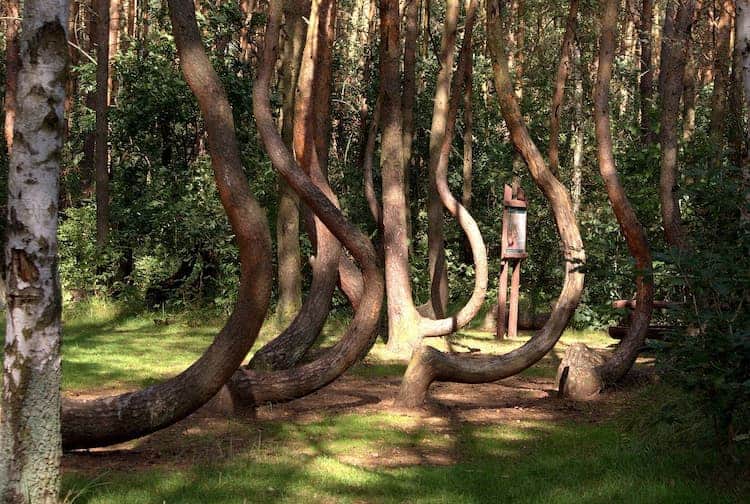
The Crooked Forest is something you kind of have to see to believe. It sits in northwest Poland right on the border with Germany and is home to a pine forest that simply doesn’t make any sense.
A lot of the pine trees in the forest started growing at a 90-degree angle at their base in a northerly direction and then up, creating a “crooked forest”. The pine trees were first planted in the 1930s but it wasn’t obvious that the trunks had become crooked until around 10 years later.
No one knows how the trees came to be crooked and there is still a debate as to whether it happened naturally due to growing conditions or they are manipulated by people to look that way.
Nevertheless, seeing a crooked forest is something you’ll never forget and there isn’t anywhere else in the world you can do it. The area is also a beautiful place to go for a long walk in the stunning countryside.
About the Author Roger Timbrook
Roger is a little obsessed with travel. He has been to over 40 countries, broken 3 suitcases and owned over 10 backpacks in 12 months. What he doesn't know about travel, ain't worth knowing!

