
Sony RX0 vs GoPro Hero6: How Do They Compare?
PRODUCT COMPARISON

GoPro Hero6
- Sensor: 12 MP
- Lens: Ultra-wide-angle lens
- Video: 4K @ 60fps; 2.7K @ 120fps; 1440 @ 120fps; 1080p @ 240fps; 720p @ 240fps
- Photo: 12MP / 4000 x 3000 px
- Jpeg & RAW
- Burst 30 fps
- ISO Range: 100 - 640
- Size/Dimensions: 1.8 x 2.4 x 1.3 inches
- Screen Size: 2-inch touch
- Weight: 4.16 oz / 118 g
- Bluetooth: ✓
- Wifi: ✓
- Mic: 3 Built-in mics (stereo front and 1x rear)
- External 3.5mm with adapter
- GPS: ✓
- Connections: USB Type-C
- HDMI Out (Type D)
- Image Stabilization: Electronic Image Stabilization
- Waterproof: 10m (33ft) without case; 196 ft with dive housing
- SD Card Type/Capacity: Micro SD (up to 256GB)
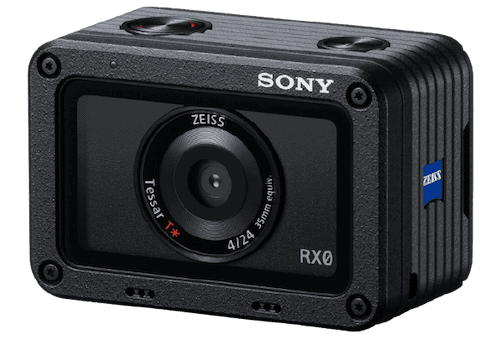
Sony RX0
- Sensor:15 MP
- Lens: 24mm ZEISS Tessar 6 element, F/4.0
- Video: 1080p @ 24, 25, 30, 50, 60 fps; (50 Mbps XAVC S)
- Photo: 15MP / 4,800×3,200 px
- Jpeg & RAW
- Burst 16 fps, max 1/3200 shutter speed
- ISO Range: 125 - 12800 (Auto), 80-25600 (Manual)
- Size/Dimensions: 2 3/8 x 1 5/8 x 1 3/16 inches
- Screen Size: 1.5 inch (not touch)
- Weight: 3.9oz / 110 g
- Bluetooth: ✓
- Wifi: ✓
- Mic: Built-in mics
- 3.5mm mini-mic jack
- GPS: ✗
- Connections: Micro USB, USB 2.0,
- mini-HDMI (to 4K video recording)
- Image Stabilization: ✗
- Waterproof: 10m/33ft without case
- SD Card Type/Capacity: Memory stick micro, microSD
GoPro is the king of action cameras, so it feels kinda strange comparing them with Sony, but the new RX0 is a worthy opponent.
The first thing to note though is that the RX0 is not really intended as direct competition to the GoPro, at least in the “action camera” sense. It is more of small, high-quality, portable camera that looks kinda like the GoPro.
However, given that they are both pretty similar in size, they are worth comparing to see which one would work better for your next adventure or filmmaking project.
Everything from lenses, sensors, to shutter speeds, video recording capabilities, and more.
First, there’s a quick comparison table above to help you get an overview and see the specs that are most important to you…
Comparing The Important Stuff
These two cameras compete in a few areas, but they are actually quite different.
So, it’s important to see the biggest differences up close.
Video
It might come as no surprise that the GoPro is more versatile when it comes to video. After all, it was designed as an action camera.
It can produce video all the way up to 4K at a decent 60fps, and lower resolutions are multiples of that (see the specs above). And it comes with built-in electronic stabilization, which for the Hero 6 at least, is quite decent.
The Sony RX0 on the other hand has no stabilization, so you will need a gimbal. But, it is intended for more of a pro audience, so I am guessing they will be used to that. It also does not do 4K (unless you hook it up to an external recorder via HDMI) but it does do 1080p at a staggering 1000fps. So, if all you need is 1080p, this thing can capture slo-mo like almost no other small camera on the market!
Images
The GoPro Hero 6 takes decent images in a brightly lit scenario but is not a camera intended to blow you away with its stills.
The Sony RX0 has a far better sensor with 15MP and a Zeiss lens on top of that. Also, it does not suffer from the proverbial GoPro wide-angle problem. Although GoPro has modes to counter this, it is still something that you have to deal with. The Sony RX0 just has a nice wide 24mm with little distortion.
When it comes to low light, the RX0 also excels because it can go to a far higher ISO and has a nice F/4.0 lens to capture far more light. Sure, it’s not an F/1.4 wide aperture, but it does a nice job from the videos I have seen of it in action.
Also, keep in mind that the Sony is designed as more of a photography device and has far more manual options that are easily accessible. Whereas the GoPro is designed more as a point and shoot, with settings as an afterthought!
Audio
Both these cameras have decent built-in mics, so you will get recorded sound on your videos. But, let’s be honest here, when a device has a watertight case, the sound is just never going to be that great. Even though they have done their best.
That is why any pro or vlogger worth their salt always wants an external mic for a GoPro like the ones from small booms from Rode. But, with the GoPro, you are still kinda limited, because the adapter is a bit of an afterthought.
With the Sony, they have a 3.5mm jack and a plate you can attach to make sure it does not come off.
Size, Weight & Construction
Almost neck for neck here. The cameras have a very similar size, and weight, with only minor differences (see specs above).
LCD Screen
The GoPro has a superior and simpler interface. The LCD is larger and a touch screen.
But, Sony is based on their bigger models, with almost exactly the same menus. But, you have to use the buttons next to it and it takes a little more setup and works to shoot your images.
Camera Mount
The GoPro created their own mount system that we have all come to know and love.
The Sony RX0 on the other hand sticks to convention and uses the standard tripod mount that all cameras have. So, the RX0 won’t just attach to your existing GoPro mounts, but you can use an adapter.
And of course, vice versa. The GoPro won’t attach to a standard tripod without an adapter either.
Connectivity
Both have built-in Wifi and Bluetooth, so can easily offload images or connect to an app.
The RX0 is built in a more adaptable way for external devices with the mini-HDMI that gives 4K and also external charging via the mini-USB. The camera can also be controlled via a computer through the USB cable and the associated app.
Apps for Your Phone
Both cameras have an app you can use with them. This means shooting, viewing, and sharing your images or videos.
Voice Control
It used to be the case that you had to click the button on your GoPro and then quickly frame the shot or use a timer (if your model has one). Now GoPro has Voice Control.
You can start and stop camera video shooting, take photos or change modes. Pretty cool huh! Some reviewers say it is a bit hit and miss when you move around quite fast, perhaps due to proximity or wind noise. So, although this is a cool feature, it might not always work as you expect.
The GoPro also takes note of times you shout or swear (in many cases) as this is usually a notable time in the video (like an accident or sick jump!).
GPS
Only the GoPro has GPS included. So if tagging your location in your images is important, then this is the action camera for you.
Price
I don’t like to give exact prices in a review as it varies from time to time and where you buy it, but the GoPro Hero 6 is a bit cheaper than the Sony RX0. Around a couple of hundred bucks.
Which makes sense when you consider the more expensive sensor and lens that are in the camera.
Which One Should You Buy?

The GoPro Hero6 is still the simplest (to operate and attach to anything) and most feature-rich of almost any action camera out there. If you simply want to shot yourself doing cool stuff, then this is the way to go.
On the other hand, if you want to capture better quality images or super slo-mo 1080p video, the Sony RX0 not only has a better sensor/lens combo but also has more extensive options like a bigger ISO range (for low-light) and a high shutter speed (1/3200). It’s more of a pro tool for very specific purposes.
